
Echoes Within
Cognitive Primitives Framework Pt 1

PS: this is a series of posts, and the framework underlined here is not complete and is subject to change. Thanks!
Have you ever wondered "how do we think?" The standard answer to this question is something along the lines of "complex chemical and electrical signals pass through the neurons of the brain, where neurons fire together and build pathways to produce thoughts." Naturally, this idea here comes in forms of depth far superior to what I just described here, and is totally right, being empirically evidenced. However, what this doesn't provide an answer to is what is the underlying structure behind our thinking? Why can we specifically think of a causing b, how a's properties are x,y,z. What governs and explains the very architecture in our thinking? Wouldn't this knowledge be absurdly useful? Allowing us to understand the mechanisms behind genius problem solver's thinking or what processes were used for the different ideas invented by people with enough detail to where we ourselves can copy and utilise these strategies in our various domains of interest. In this series of posts I'm going to upload, I'll talk about my model of thinking, distilled into fundamental axioms, which alongside other variables such as sensory data, working memory, and association provides an explanation to how thoughts are formed! This model is NOT complete, and will need to gradually be refurnished and upgraded over time into something that works.
However, there are a couple of caveats needed to be mentioned.
Supposing a complete cognitive primitive framework were to be generalisable to all people, that allows us to identify the algorithms producing thinking but they don't answer the other half of thinking; the association networks that decide what objects feed into the algorithm to be operated on. This entails in practise links between concepts and information and patterns, which is a completely different component of intellect and problem solving which will not be able to be adjusted by this framework significantly. What the framework on the other hand allows us to do is be able to have the capacity to form set concepts, information and patterns (slowly due to processing speed constraint) and also allowing us to identify them in the first place, diagnose how our thinking differs from another.
Another limitation, which is the determinant of the association described above, is that limits in working memory, fluid intelligence, processing speed affect our ability to actually form the patterns themselves when first encountering information. Therefore, this framework functions mainly as a tool after an error in problem solving, allowing us to form generalisable solutions and patterns that can transfer beyond the context of the problem or aid us in thinking of ways to use existing ideas via testing as although it is possible to use it to deduce new concepts and links, in a timed environment at set constants described above, the rare specificity of the combinations allowing for certain links between information mean it's use is slow and effortful, being inefficient especially in timed environments.
And finally, the process of modelling thinking is done through me utilising thinking itself, meaning my observation of this system is constrained from within the system's tools. This also has the implication that a different set of primitives may be possible depending on how we define the components involved in this system, but what differentiates this framework from that is it's grounding in how we physically feel thoughts as, because whenever you perceive something, it's like our mind adds certain characteristics like its spatial volume, the position of it relative to other things and so on.
Now, I'll state my list of the fundamental cognitive primtive and the rationale in these being the axiom here. It is as follows:
Distinction: a process through which properties and other thoughts are compiled into thoughts
This entire thinking process can be modelled through these 2 diagrams:
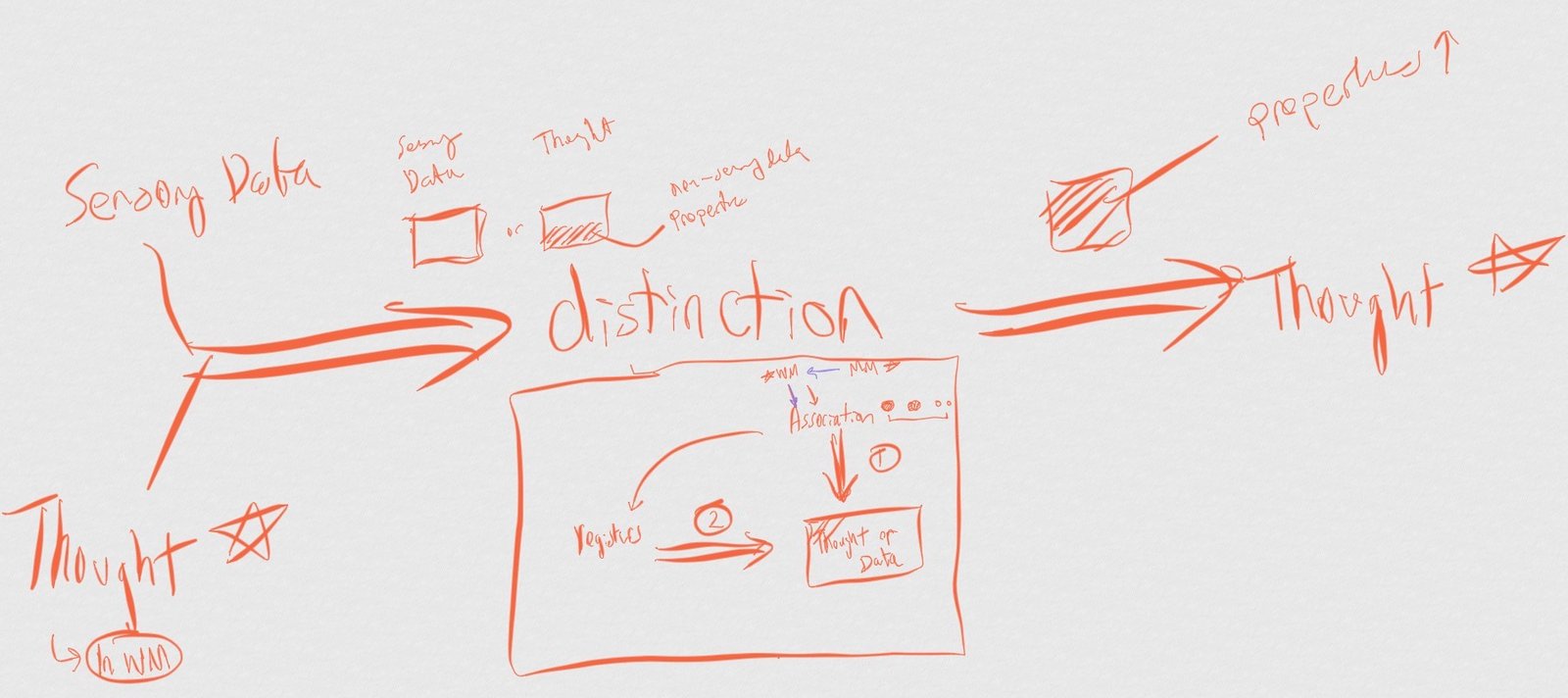
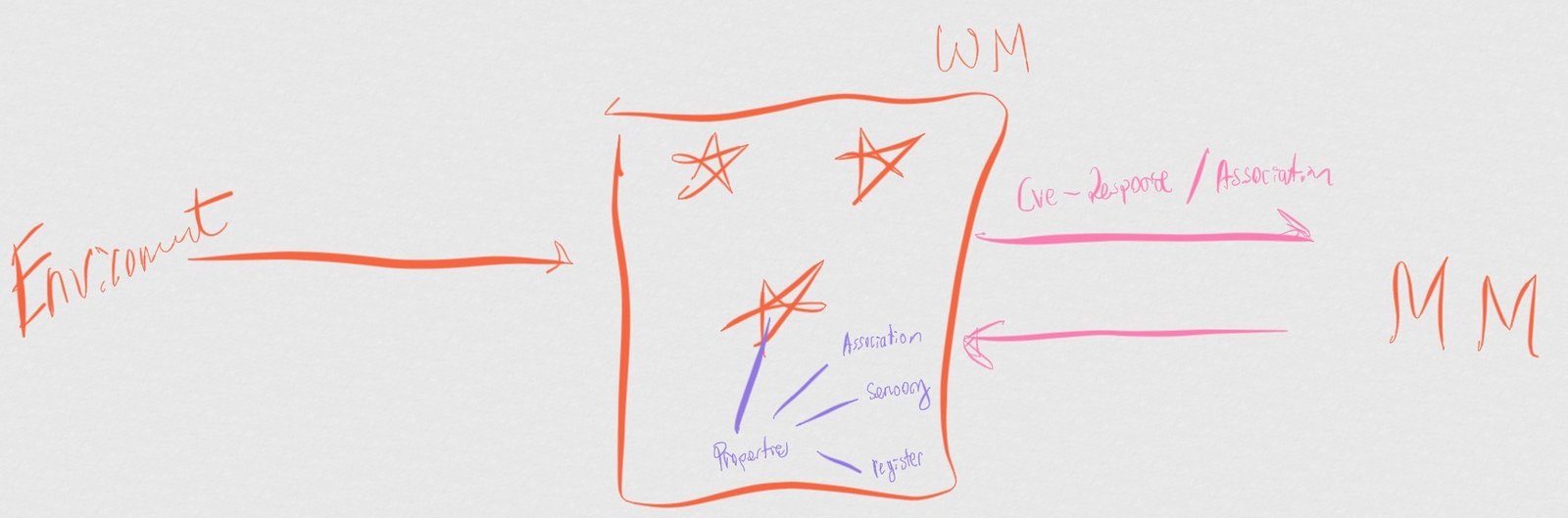
Above, the stars are thoughts, WM refers to working memory, and MM refers to main memory. This has simplified other findings in psychology as this simple model is the foundation of other more complex models, which have details not significant to the claims I am making.
To understand this, lets begin with the stars we see in the second picture. These represent thoughts, which have the properties of association, registers, and sensory data.
Association is defined as a property that is the relation with the properties of one thought with the properties of another thought, where relations are the degree of overlap. This overlap can be thought of as a Venn Diagram, with its extremes being equality/the same/iteration and the other being totally different. Negation, and not is a consequence of a different causal chain that will be delved into later.
Registers are defined as the properties of thoughts that are operators applied to thoughts, each being unique and indivisible. The registers are (these like anything else in this model is subject to change):
Spatial Intuition: The relative position, orientation along an axis, symmetry along an axis, extent (space taken up), closure (a boundary closing on it self)
Sequence: The order of things (defined by edge)
Quantity: How much
Edge: A boundary between one thing and other (what one thing is and is not). Graduation is also defined here as its absence.
Sensory Data (this is explicitly separated from the others as its often initially there in information that our brains process through the senses): whatever our senses process, e.g temperature, taste, images, and such.
To understand this better, lets take the example of seeing an apple, where we assume its our first time. The image of the apple enters our working memory through the environment, here distinction is applied, where this sensory data gains the register properties applied to it: e.g edges being carved out from the edge property, and its volume from the spatial intuition property, and this process applies till the relevant primitives are applied. Our brain does this automatically though the registers being applied may depend on other variables not discussed here (e.g how often it usually is used based off cues we're used to, that have strength dependent on the environment and genetics). While this is occuring, also the association property is being added, where these different properties (including sensory data) are being compared to other information in working memory and by cue-> response in main memory. Once this is done, the thought is now finally complete, having the register properties and association properties, where we recognise it as "apple" based off this unique property signature.
To get the idea of fruit, we through a similar process abstract banana, and either A through its pre-existing similar property association to apples apply distinction to it, or B just acquire this property association with just having the thought apple and banana more frequency (triggers this process again just faster), or C, compare the two in working memory consciously unlike the subconscious processes formerly described. Then if any of these cases occur, we have these two distinct items being treat as a larger item (2 items of edges), where then we can see the shared associated register of for instance fruity sensory taste. This alongside other similar properties can be abstracted into fruit, with the association to these 2 as the thought's properties alongside the properties of the fruity taste.
For some closing thoughts:
The model seems to work for simple cases like abstracting an object, and even negation (which is through the thought being in main memory and you thereby the cue of suppose x trigger the registers sequence with x,y, and the lack of y which u compare this pattern to is what produces negation (the association of not y).
The diagrams seem to neglect multi-object explanation especially with the non-produce object case, as it is of a different algorithm/process where the initial properties are not kept (e.g orange being orange is no longer kept in fruit, only even remotely there by association). This is to be settled later.
Thanks for reading! Remember this is simply the entry point on this journey of perfecting the framework, and any feedback would be appreciated 🙂